Wednesday, January 27, 2010

Comments from HNRS 353

I think companies are also starting to realize that games can be good advertisement.

Particularly movies - if you go to a movie website, you will often see a game of some sort. I actually thought that this game might come up in our discussion of Columbine, because the killers were Matrix fans and almost definitely played this game, which was available on the movie’s official website (and still is). In the game, you are Neo or Trinity, you choose a gun, and you play the scene where they shoot up everybody to get to the elevator. There is Marilyn Manson (I think? or someone similar) playing in the background.

But that tangent aside, nowadays I think games are becoming a useful tool for advertising in their own right, not just as a part of an ad. Look at America’s Army, which we discussed, which is basically a giant ad for the Army. Then there is Virtual Magic Kingdom, which I’ve mentioned in class, which has no subscription fee but is a giant advertisement for the Disney parks and is one more tool to get kids to bug their parents to take them.

I definitely get what you say about the Warioware aspect of the flash ads (which I don’t tend to see as much since I have adblock and flashblock on in firefox). Some of the ads, even though they are blatant ads for something I would never get, I have played the little flash game for (and so clicked on) because it looked fun or funny. What better way to advertise a mortgage loan than offering to let you punch George W. Bush in the head with a boxing glove?

May 5, 11:32 AM — [ ] — Games, Games everywhere


I fully agree that all games have narrative qualities. I’ve had games move me emotionally more than films or books.

I was sort of thinking of the written quality in my post. For example, if The Baron, with pretty much the same descriptions and wordings, were made into a short story, it could probably be published. But it isn’t a short story, it is a game, and so it is dismissed. In a way it reminds me of how in 1993, Neil Gaiman won the World Fantasy Award for short story with a comic. The rules were changed shortly after to say that other forms were not valid. What if someone had submitted an IF like the Baron to the awards? Would it have been taken seriously enough to be considered?

When playing IF, I have seen writers who were bad and writers who were good. The good writers were better at description, narrative, pacing, and characterization than Dan Brown could ever dream of being, and yet he is taken seriously as an author and they are seen as game writers.

Apr 27, 10:38 AM — [ ] — A Fusion of Media Forms


Blogging Threefer

April 25th, 2008 asgoodwin

I think that my posts I wrote and half posts I saved during the semester were more insightful into the readings and games. I was closer to them, so I wrote better on them. I wish I had been more diligent about posting in the blog, because I’ve noticed in this and past classes that what I post at the beginning is really interesting, and I don’t necessarily remember it in the detail I wrote.I think that blogging is a good tool in a class like this. I definitely played The Baron more closely than the other classes we played before class but didn’t blog or write an inquiry about because I knew I had to write on it. Particularly in the last unit, more “assigned” blogs (for example, telling us to blog on a game, or on a reading, or just “before class”) would have been a good assignment, because there is a lot to take in and analyze in that section which is controversial in a way that the first parts of the semester weren’t. Sometimes just writing down your reactions is a great help in digging deeper and understanding your reactions to things. I didn’t think to sit and blog after we talked about the Prison game in class, which I had such a gut reaction of dislike against.

I think it also shows me the ideas I kept coming back to over and over again. For me, a lot of what we discussed in the beginning of the semester about games, how they are constructed and how they tell stories, related in my mind to Disneyland. Part of this is because I’m just a Disney nut and it’s on my mind a lot, but also I think it is an interesting parallel to draw. I also liked the Combat in Context essay, because I felt like I understood it in a more real way because I’ve looked at those levels in my past programming assignments.

I’m not sure that my post style has changed over the semester, because so many of my posts came right at the end (as in today). In other classes where I’ve had to blog, I do usually see a more in depth understanding, and I definitely go back and refer to them even now after the semester is over to remind myself of what I’ve learned.

I did notice occasionally in class I would hold back from saying something I’d thought about the readings (usually it was fairly tangential) because I thought I would put it in a blog instead, and I’m not sure that was helpful in the end because the discussion in class would have contributed to the idea more than me rambling in a post. Still, despite that, I think that blogging is a very good tool for keeping track of what I’ve learned during a semester, my thoughts on it, and looking deeper into the readings than I would have otherwise.

Interactive Fiction as Literature

April 25th, 2008 asgoodwin

One idea we discussed in my class last semester, Textual Media, was whether Interactive Fiction can be seen as literature. In my mind they can.

I’ve played many games, both in high school and again last semester, and the quality of writing and plotting really does make a difference in the story. The author is incredibly important to the game, particularly in their ability to describe the scenery and drop hints towards the overarching story without being able to make the character do something in the room.

Looking at The Baron, there are metaphors and symbolism in many items. Part of the strength of the story is that there can be hints in places that the author isn’t necessarily sure you will reach. In the story, there was a prison underneath a grate in one corner of the Baron’s castle. In class, I was the only one who had found it. In it, there was a “father” doll tied up, and a “mother” and “daughter” doll inside a cell, starving, and he couldn’t reach them. On the other hand, I missed the part of looking into the dollhouse and at the drawings in the daughter’s room both before and after I was in the dream world. Still, I felt like I got a well written and shocking story even with what I had seen and what I hadn’t.

Of course, Interactive Fiction could never replace literature. However, I think more writers should consider experimenting with it as another form of storytelling. It is like a first person story made more intimate, as we discussed in class, because you are making the reader choose what they are doing. I think a large part of what made The Baron shocking in the end is that the main character – you – are doing that horrible thing to your daughter, and as the protagonist player you feel even closer to the character than just reading a first person story.

Entry Filed under: Game Log

3 Comments

  • 1. Dennis Price | April 29th, 2008 at 11:36 am

    I definitely agree that Interactive Fiction is literature. It could obviously never replace literature, but it certain deserves to be considered a tpe of it. I think the most interesting thing about Interactive Fiction, aside from the stories, is when it is set up like a game like Baron was. Not only does this allow the narrative to be "choose your own adventure", but it makes the player feel like they are a part of the story. In The Baron, the player is able to identify more with the character since he has direct control over him. Normally in literature, the reader is going to hate a child molester. That still happens in this game, however, the player is able to identify more with the internal struggles of the Baron. The player is forced to make decisions as if he his self were a child molester. He is forced to think about what he would do and how he would feel if he were in that position in real life.
    While traditional literature can also allow the reader to enter the minds of the characters, the Interactive Fiction takes it to another level by allowing the reader to make decisions. The fact that it is set up as a game also makes it interesting. In a game, especially text based games, a player can and usually expects to do whatever he wants. However, in The Baron, the player realizes he is trapped and is forced to confront his daughter. This sends a strong message, in my opinion, that some problems in life are impossible to avoid. This is an extremely important message and it would be difficult to illustrate it so well without using a text based adventure format.

    Edit Comment
  • 2. scify_rd | May 2nd, 2008 at 11:21 pm

    I think that the largest issue that stands in the way of Interactive Fiction becoming both a serious genre of literature and really at all practical for writers to create is the sheer number of options that are inherent to gamers in game. There is, of course, always the convention of "You can’t do that" or "You don’t feel like doing that right now" type responses, but those are usually very frustrating to come across, unless they are for particularly outlandish actions that the character, as described, would never try, and often take much of the realism out of the story (after all, in real life we do not come across little flying banners or voices in our heads that say "No. You may not do this." when we think of something we would like to try).

    However, as a collaborative effort, at least, Interactive Fiction could be a very interesting genre of play/narrative experience, and one deserving of exploration by serious writers. The biggest issue would be the time investment, really, as the sheer range of actions that… let us call them, interactors, might come up with in the context of the story being told.

    An interesting note on this point is the fact there is a genre of storytelling where each chapter ends at junction of possible choices and the readers are given the opportunity to pen both possible results. While the average person does not have the coding skills necessary to do the same with an interactive fiction game, it could be interesting if there were eventually some similar form of story crafting for games.

    One final note: there was, in fact, a guide on how to achieve the various endings for Facade. It cost $10, I believe, but…

    Edit Comment
  • 3. mstarkey | May 5th, 2008 at 5:50 pm

    Interactive fiction as literature is an interesting concept. I totally agree that Interactive Fiction is truly a form of literature. In many ways Interactive Fiction engrosses the reader more then typically literature, forcing the reader to be actively thinking about the story, where its going, what clues have already been given, and alternative meanings. Being in high school literature classes, it is easy for the uninterested reader to skim over passages and take them at simple face value, missing important clues and points the author tries to have the reader uncover for themselves. Many missed the true meaning of the story that the writer intended. The nature of Interactive Fiction prohibits that, requiring attention to the story to progress in the game. There is no last chapter that one can flip to to find the conclusion, or answers, instead there are multiple endings and variations that make the story unique to the reader. Yet the playing aspect keeps the reader interested and involved, allowing them to contemplate the relatedness and importance of every scene or character. The decisions that the player makes during the game are the decisions that the main character of literature would be making. Instead of reading the decision the character chooses, Interactive Fiction allows the player to decide what actions the character makes. With literature the reader is either left questioning the outcome of other possible decisions the character could have made, or just takes the decision made as the only one, leaving out questioning and in-depth thinking on the readers’ part, which is crucial for literary analysis. Interactive Fiction allows the player to experience alternative decisions, furthering the depth and meaning in the story. The ability for the character to choose the path it takes in the game furthers the story provides additional background information to both plot and character development. These developments within the story are presented as decisions to the player; help keep attention and involvement on the players’ behalf. Alternative endings and alternative paths through which the story unfolds does not detract from the meaning of the game which the creator intended, it just allows people to create their own story to extract the meaning the creator intended. The player’s active role in unfolding the story beyond page turning is what really attracts me to the literary value of Interactive Fiction.

Disney and Progressive vs. Emergent Play

April 25th, 2008 asgoodwin

Yet another from me…

In an essay by the blog Re-Imagineering, they discuss the difference between Story and Plot in themed rides. I don’t entirely agree with all their points (I generally don’t), but I thought it was an interesting thing to look at in the context of Emergent and Progressive play. Emergent play has story – an interesting environment, and an interesting world, but not necessarily an A to B plot. For example in It’s a Small World, where there’s no actual plot, just the story of a world where all the children of the world realize they are alike and come together to sing. There is no beginning, middle, and end. There is no protagonist or antagonist.

On the other hand, there are a lot of rides with progressive plots, like Splash Mountain, where Brer Rabbit decides to leave home, is caught by Brer Fox and Brer Bear, tricks them into throwing him into the Briar Patch, and finally realizes home is where he is meant to be.

Many of the rides fall somewhere in between. The plot isn’t explicitly mentioned, but it is there. In Big Thunder Mountain, you’re on a mine car, in an abandoned mine town, which has gone out of control. In the Matterhorn Bobsleds, you are sledding through the mountains and have a run-in with the Yeti, barely escaping.

One story which has shifted from story to plot is Pirates of the Caribbean. The old version of Pirates of the Caribbean, with pirates ransacking a town, looking for treasure, and generally acting piratey, is a similar world. There are mini stories throughout, like the “wench” auction, or the pirates in jail trying to tempt the dog holding the key, but nothing holds it together. In (2005?) Disney Imagineering reworked the story to have a plot in it, of Jack Sparrow. The opening scene with the pirates attacking the town, they are looking for Jack. In the town, the man dunked in the well is being asked where Jack is. The drunk with the map is trying to hide it from Jack, who is peering over his shoulder instead of a random other pirate, and finally we leave seeing Jack in the treasure den. A lot of people strongly objected to the addition of these scenes, because it took away from the emergent story and added a linear storyline. They felt this took away from a primary joy of the story.

Ultimately most people concede that it makes the ride more familiar to younger riders, and it makes the ride “make sense” to more people. Both forms have strengths, and there are people who really prefer one over the other.

Looking at these examples really made the issue of the two types of play make more sense to me, so I thought I would share it with all of you.

Entry Filed under: Game Log

1 Comment

1. Professor Sample | May 14th, 2008 at 9:59 pm

This is really interesting to hear the Disney people’s distinction between plot and story, because the two words have a different meaning in literary studies. The Russian Formalists most famously argued for the distinction between the two, in which story is the chronological series of events of any happening (what Boris Tomashevsky calls "the action itself), while plot is the order in which the reader (or viewer) learns about each event. Flashbacks, for example, jumble the story by presenting it "out of order." What’s intriguing is that there is a tension between how events occur and how the reader is told about these events, and the greater the discrepancy between plot and story, the greater the tension in the narrative work. I wonder how this version of "plot" and "story" applies to videogames…

Further Thoughts on Combat in Context

April 25th, 2008 asgoodwin

In the rubric in Combat in Context, Nick Monfort describes the platform as driving all the other parts of the game development, as step one of analyzing a game. We discussed this some in class about how the increase of memory and graphic capability has made games more realistic and complex. I was thinking about this, and I think a great case study to look at is the Nintendo DS and the Nintendo Wii.

Games for all the systems before these two came out were mostly the same, because for the most part the systems had the same types of controllers – the XBox, Playstation, and GameCube, and even before that Nintendo 64 have similar controllers with buttons and joystick motion controllers to allow you to go in more directions. The Nintendo, Super NES, and Sega Genesis all had the four arrows and buttons set up, which also was present on the Gameboys and Sega Game Gear, though those had less memory than the full fledged games.

The Nintendo Wii has been selling hugely, and part of that is the innovative games present on it, nearly all of which are a result of the new game platform and controllers, like the WiiMote, so you can bowl and play baseball and other things that are not as “realistically” done, at least motion wise, with the old fashion game controllers.

The DS, with its touch screen technology and dual screens, has lead to new games and new types of play that wouldn’t have been possible on older systems. Everything from controlling your character by dragging a line in front of it, to having puzzles you must solve by writing, to having maps you can make notes on like in Zelda: The Phantom Hourglass.

Part of the reason the games are exciting people because they seem so different is because the programmers are challenged by the lower level hardware presented to them, and in order to make a great game for the system they must actively use those capabilities in a way that is interesting and necessary to the game, or people will be tempted to move on to other games that use the hardware better.

Disney Parks and Environmental Storytelling

April 25th, 2008 asgoodwin

In our last reading, Game Design as Narrative Architecture (First Person pp. 118-130), the author Henry Jenkins quotes Don Carson, a Show Designer for Walt Disney Imagineering. The section was about Spatial Stories and Environmental Storytelling. I was having trouble classifying the difference between the two types of storytelling, because I didn’t have too much experience with Half-Life or Halo, which are the two stories most often used as examples, but this made me think about what I know about the Disney Parks and how they treat both storytelling types.

Disney Parks have a lot of great examples of environmental storytelling. In a way, the park can be seen as a game where you are the main character - many of the designers talk about how it is designed to be like a giant movie that you can actually walk into. Take Disneyland (DLR) in California or the Magic Kingdom (MK) in Florida, for example. There are seven major areas - Main Street USA, Adventureland, Frontierland, Fantasyland, Tomorrowland, Toontown, and Liberty Square in MK and New Orleans Square in DLR.

In none of the “lands” are there progressive, linear story lines. Sometimes they show up in rides, but the land is all about “environmental storytelling.” The entire land conforms to the idea. There are details that you might not consciously notice but contribute. Walt Disney was very strict about having the worlds always stick to the story they were telling, and nothing should be out of place. There is a story about how he once saw a cast member in Tomorrowland clothes walking through Adventureland. He stopped the man and asked him what he thought he was doing? The man said he had to walk through Adventureland to get to his car. Promptly after that, Disney had a road built around the outside of Disneyland for cast members to use to get around, and when he built the Magic Kingdom, he built it over a first floor called the “utilidor” which cast members can use to get around the park out of sight.

There are bits of progression in the lands of Disneyland, but they aren’t obvious. For example, at the start of Main Street USA there are gas burning street lamps. By the end, they are electric. Other details add into the “story” of Main Street, the innovation of technology that came about from the turn of the century to the more ‘modern’ day. There are many challenges to this environmental storytelling you might not have in a game, where you can cut from one scene to another. In Adventureland, there is a statue of asian water buffalo which were chosen, because if they were seen from Frontierland on the other side of the building, they would look close enough to longhorn cattle to not stand out. Also, all of the music in Disneyland is on the same tempo, so that it can unobtrusively blend from the music of one land to another as you walk under a bridge from Frontierland to Fantasyland, or Main Street to Adventureland.

On the other hand, many of the rides are Spatial Storytelling. Like how games scroll along, the rides tell as story in what you see as you travel through the ride. Like a movie or a game like Mario or a Chinese painting on a scroll (as the author uses as an example), as we are taken through the space we see the story unfold past us in a more linear way.

It is neat to see these details that we so associate with games in an actual real life example.

First experiences with videogames

April 25th, 2008 asgoodwin

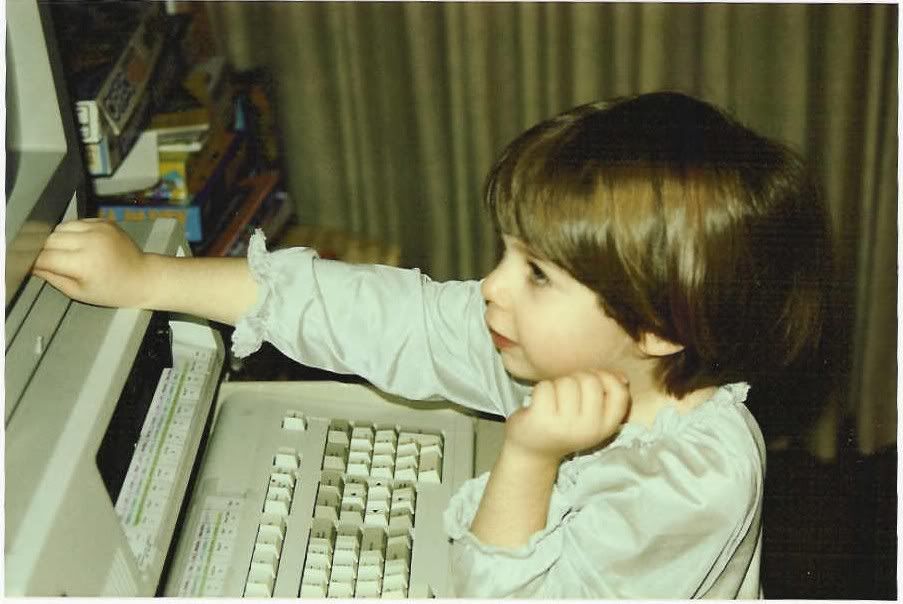
I remember when I was younger, we always had video games. This isn’t literally true, but as far back as I can remember we did. Here’s a picture of me at about three playing with a computer (wasn’t I cute?). We used to have Lemmings and Wordtres, both of which were on 5 1/4” floppies.

After that, my older sister got a Nintendo (original) and I remember watching her and my dad play Dr. Mario before going up to bed. She and my dad also made their way through Super Mario 3, and I remember there were days when we couldn’t use the downstairs TV because they’d left the game on paused, since of course you couldn’t save. We also used to play the Chip ‘n’ Dale Rescue Rangers game together. She was always Chip, and I was always Dale. Even now when I go to Disney and they have Chip & Dale out and about, I’m more excited to see Dale because he was my character.

Then we got Super NES. That lead to games like Nintendo Tennis, which we played without end against each other (my younger sister sometimes joined in, but not as often). We played F-Zero a lot too, which made me greatly excited when it came out for the Gameboy Advanced (my sister was very excited to play it too). We also got our first Mario Kart for that, and in that game we were the most competitive and vindictive. Hitting each other with red turtle shells could cause a fight that would last for days.

Our next system was Sega Genesis, and again we went back to cooperative games, and I would take the second fiddle. I was always Tails when we played Sonic the Hedgehog together – not that I minded, because Tails was cuter and could fly, and I was Donald when we played The World of Illusion Starring Mickey Mouse and Donald Duck. World of Illusion was the first game I remember beating. There was this connected excitement between us as we worked together and finally beat it. This was during a time when we’d fight at the drop of a pin, and it was the one thing we really connected between.

Later we got Nintendo 64, which was our last shared system, but we didn’t really play much together. A few years later I got a Playstation 2, which stayed in my room, and my younger sister got a Gamecube, which stayed in the family room but was still primarily “hers.”

I look back fondly on those times we played video games together. It was probably the closest my older sister and I ever were - at least, it was the most time we spent together just playing.

The Baron

March 6th, 2008 asgoodwin

I think playing The Baron would have been more interesting if I hadn’t read the introduction in the menu before playing. I understand why he would want to give a warning of dark themes, but it left me far more critical of it than I would have been otherwise. I ended up judging less what he had done and more what he was trying to do.

I do admit it is more interesting and creepier on second playing. The first time is confusing, and fairly surprising at the end when you find you *are* the baron and what you have been doing to Maartje. The second time though, you see the alternate answers and start to understand what they mean, about doing this every night, about saying things to the baron about you-we (which if it hadn’t been an option would have made the revelation more surprising). The castle is also a lot more creepy when you realize it’s in his head. The question and answer with the gargoyle was more significant as well. I was also a lot less sympathetic to the main character on the second go, knowing more about him. In many ways I think the game was written with the second playing in mind more than the first.

I thought it was an interesting experiment in writing, but as others have posted, I don’t think the *form* was as vital to the story as it often is for other IF games. You could easily see this as a short story. The storyline is fairly progressive - reading the other entries, I see some have experimented and found it very linear, with the input of the user making little difference. Of course, you don’t realize this the first time around, and having it be IF does make you identify closer with the main character than a novel might. However, I don’t think it truly takes advantage of the form for an emergent story in the way Galatea does.

Model from Combat in Context

February 5th, 2008 asgoodwin

I was thinking more about the model for analysis of video games from the Combat in Context article.

Just as a reminder, the model is 1) Platform, 2) Game code, 3) Game form, 4) Interface, 5) Reception and Operation.

It is good at describing the dependency structure of a game - code is restricted by capibilities of a platform, form is restricted by the capibilities of the game code, etc. It is also a good description of the bottom up computer architecture. I’ve seen similar levels used to analyse computer programs, and programmers will often talk about the “low level” and “high level” programming similar to this. (Low level will be closer to the computer hardware, programming operating systems for example. High level is a code built on other programming codes, like scripting languages, and the interface and graphics are usually thought of as a high level part of the programming.)

However, I’m not sure it’s the best way to evaluate games, particularly for use in analysis like what we are talking about in our class. I think the computer code section should be expanded to include all the game design from concepts to art to story to the gameplay to code, even though in the end the code will eventually program all the others. I think the other areas are as vital, if not more, to the video game, particularly when looking at it in the same context as film studies would look at film. In general, I don’t think elegant or sloppy code is very important to the game if it has the same output result, except if it causes crashes. In the article, he talks about how the capabilities of the platform - no room for buffering to the screen - made the programmers write the code differently. It is important to know that, but ultimately is it more important to looking at the final project than the concept writing for the game?

If you look at the model as a timeline, then the position would still be the same, but it opens it up what the model can use in examining the game.

(Of course, in my mind the game form is more the “finished product” - what you see and what the code builds. The author might be seeing some of the concept/design stuff there. It just feels a bit off to me the way it is now, in terms of considering the whole game.)

Friday, February 1, 2008

Comment for HNRS 353

I think it's actually Sisyphus who rolled the stone - Icarus was the one with wax wings who flew too close to the sun.

I completely know what you mean, though, and I think that's a really good metaphor for a lot of these early games. I'm not a huge fan of pacman, as I mentioned in class, and I think this sense is part of the reason. I don't particularly like the game plan and the urgency of running around, and if you succeed and get to the next level, what do you get? More of the same.

I think this also goes along with why I tend to be drawn to RPGs, or games with some plot be it narrative or emergent (but there). I like to feel like the progression means something, not just a step closer to a level that goes too fast for me to finish.

A lot of early games suffered from Sisyphus-syndrome due to lack of ability to save, too. I remember with the original Super Mario game, if you turned it off you lost your progress. That led to long periods of the game being on overnight or during dinner and such, but we definitely got more familiar with those early episodes than we wanted to just to get back partway up the "hill" to the later levels.

Monday, December 3, 2007

Cyber-bullying

My name is Amy Goodwin, and I did a project on cyber-bullying for Textual Media (ENGL 348) at George Mason University. I wanted to open up a place for people who have seen my project or have stumbled on this by mistake to be able to comment on their experiences. Comments can be made anonymously or logged in. The journal is set to allow both.

Please share your experiences with cyber-bullying, either as victim or instigator, or just reflections on the problems caused by it and the difficulties in preventing it.

Thursday, November 15, 2007

Dear Representative Christopher Van Hollen, Jr,

I am writing about the bill HR4137. In one section of the bill, it suggests that federal funds for financial aid should be contingent on issues of "digital theft," pulling federal financial aid for all students if the university did not agree to test technology-based deterrents. As a college student, this bill makes me very upset.

I think this is incredibly unfair to all students who are in university or may one day hope to attend a university. On a most basic level, holding hostage financial funding for low- and middle-income families in order to help corporations preserve their bottom line is unethical and unfair. I don't deny that file sharing does lose money for the complaining companies, but to blindly punish certain students, even if they do not own a computer, and certain universities which rely more on federal funding than others, is not the right solution.

Then there is the question of what will satisfy the deterrent qualification. Some universities offered an opt-in music subscription service as an alternative to file-sharing, with moderate success. Articles criticizing this bill suggested forcing people to subscribe. Is this fair again to lower and middle income students? To increase their tuition even small amounts in order to pay off the MIAA and RIAA, when even that subscription fee could make it impossible for them to continue at the university or to pay the rent or eat. As a college student, I find this very upsetting. I have friends who can barely make ends meet month to month. They live off campus and take the bus to class in order to save money, and can end up living off of the good will of friends and low cost foods like ramen noodles by the end of the month.

Another solution is to cut out all possible peer-to-peer networks, for example all torrent files. This is also not a very good solution. There are legitimate reasons to use these files - from simply an easy way to give a big file to a classmate for a project, to downloading large files like linux distributions, which are free to use and share but are too large to share easily in other ways. If we start limiting types of files or certain sites, we limit the free speech and ability to learn. There are also cases where files are being used for fair use in courses, which would be restricted. I can't think of a place where having completely open access to the internet and information could be more important.

I don't download music illegally, I prefer systems like iTunes. I also don't need federal financial aid, because I am fortunate enough to have been born to a family that can afford college and is willing to support me through my education. Neither of these facts make this bill less troubling to me. I know it would fundamentally change the quality of my education, through the access to information I have, the respect and trust for the university I hold, and the people I get to know.

Thank you for taking the time to read this note.

Sincerely
--Amy Goodwin

Thursday, November 1, 2007

Free Culture by Larry Lessig

As a brief preface: I hate to say it, but sometimes I feel like this comic. I keep up to date on the issue, following the latest news at sites like slashdot, but I don't feel as strongly as them even though I still feel stronger than the average American.

Lessig discusses the protection of content vs. protection of form of content. This issue, I believe, is one of the most interesting. We discussed in my other class as well this situation with the adobe e-books, with all the restrictions. At one point, they even restricted copies to a single computer - if you buy it at home, but want to read it at work, you have to pay again. This is for works in the public domain - works that are supposed to be free. They also get into their restrictions of what you can copy and how much you can copy, all due to the "form" - their ebook, rather than the content - a work which is in the public domain and can be used in any way anybody wants. It is also of sketchy morality to sell something which should be - and sometimes is - available freely on the net.

Part of the problem, as we have discussed in my other class, is that companies are desperately trying to cling to their old models of the world - ones which do not involve the world wide web. It is understandable - the internet as we know it is an invention of the last decade, whereas book publishers and music companies have had their systems at work for far longer than that. Instead of moving with the times and trying to take advantage of the new market, even if it means losing some control over their products, these industries are sticking with the inertia of their state and trying to force the new technologies to behave like old ones. Some textbook companies will sell textbooks online - with passwords, that expire after a term. It is true that this will keep people from just passing on the file to a friend who takes the class the next or same semester, and will kill the second hand textbook market, but it is a ridiculous and exploitive idea. Demanding that people pay for a book, even if it is not as high a price as the print textbook, for something that you will not be able to use as a resource later, will not be able to resell - which the law allows, and is a good way of recouping some of the money expended each semester - is unreasonable.

Other companies, like overdrive.com, offer ebooks to libraries, which is a great idea, but again they try to shoehorn it into a product that it isn't. They not only restrict how long you are allowed to open the ebook - a perfectly understandable restriction, as you can't keep library books forever either - but they restrict the number of copies that can be taken out at a time. This is a completely arbitrary restriction - there is no reason every person who logs on couldn't be able to take out the same book - but is put together in a very stupid way (IMO) - books are not "returnable," they just expire, so there is no way to free up a book you finished for others to get sooner, like you might return the library book to the shelf. As a result, almost all books are already "taken out" and once a copy is out, there is a mandatory three week wait until it is available to another user.

The Importance of Science Fiction

This came to my mind once in class, but the conversation moved on before I brought it up. We were discussing how


...to finish later.

Tuesday, October 30, 2007

Screen Grabs: The Digital Dialect and New Media Theory

There were several things in this article that I found very interesting, but the one I think is most important to discuss, and that we haven't discussed before, is the idea of "bit rot."

It comes up on page XX in the introduction, when he is defending having published a book instead of releasing it online. He says, "Nothing ages faster and become inaccessible quicker than electronic media." It's true, you can look at even just the storage that has evolved and what is now obsolete - 5 1/4" floppy disks, 3 1/2" floppy disks, zip disks - thought to be the next new technology and actually installed in computers, now never seen. CD-ROMs became pretty standard, but that's now becoming displaced by DVD-ROMs.

It really is a problem in terms of getting people to embrace technological copies of things. People are happy to try new technologies, but they don't want to use them for anything lasting, like books or music. People are happy to use new technologies and hype them up, but if you ask them to invest in technologies that they're not sure are steady. VHS and DVD have been embraced, though VHS is dying. But people won't invest in Blu-ray or HD-DVD except the people who really want to be at the forefront and have the best new gadgets, because one will triumph over the other at some point.

My dad, who does photography, runs into this problem. Negatives can fade or break, but people know how to take care of them. However, if you store digital photography on cds, the CDs will fade after a while and people don't know the lifetime of them. On top of that, you may save the file in a format that becomes obsolete, and you won't be able to retrieve that picture again, whereas the negatives and enlargers have been used for the past hundred years, and will continue to be used in the same way as they have for a long time to come.

Some systems are backwards compatible, but to build a less clunky, more efficient computer system you need to take out the backwards compatibility. Windows XP upset a lot of people because it wasn't backwards compatible to Windows 95 or 98. New game systems like X-Box 360 weren't backwards compatible, which upset a lot of people, so they released individual patches for individual past games.

It really is a barrier to embrace of technology as a whole, to assure people that they can embrace technologies even when it's going to be replaced sometime in the future.

Tuesday, October 23, 2007

Harry Potter and the Internet Meme

I think it would be interesting to discuss in class how the "Dumbledore is Gay" announcement was spread so quickly around the web, and how it organically (or virally) spread from location to location before it even was picked up by mainstream media. It was really interesting to watch how long it took to reach some places and how quickly others, kind of like an earthquake - an epicenter and gradually spreading ripples spreading out from it.

digital photography

I think digital photography is an interesting new technology - I've been following the evolution of the technology pretty much since it became commercial, because my dad does fine art photography and has been trying the technology since it came out. The first digital camera he got was 1.2 megapixels, which is less than my phone has now. He now has a 13 megapixel camera, which allows him to have the picture stretched and printed at 11inchesx14inches without pixilization, so it is actually a reasonable substitution for traditional photography.

One of my dad's dislikes for digital photography is that you can photoshop it to take out problems - kind of like painting. With a painting, you can "edit" while you paint to take out things like telephone poles from photos of beaches, etc. whereas you had to actually find the picture with photography. Now, you can *take* that picture and just make it "look right" to you.

Photoshop is fairly easy to do - websites like fark.com have photoshop contests every day that show really realistic (or not, depending on the contest) photos. Something Awful does photoshop phridays with similar ideas. It is a problem when one of these images are taken seriously and spread around the web (you can typically see examples on snopes.com of images that started as jokes but were then taken seriously).

An example of a fark.com photoshop:

(the original)

and

This movie I thought was also very interesting in terms of ease of photo manipulation - becoming easier every day.

Tuesday, October 16, 2007

Games and Noise

I thought the point about interpreting noise and decoding messages was really interesting, because I used to be really interested in cryptography. My interest really started with Alan Turing, one of my personal idols, who helped build the machine that decrypted the German codes during World War II. This is a good example of the Maximum Entropy Formalism, where you leave your mind most open to ideas to find the right solution. In this type of encryption, each letter is not only encrypted, it not necessarily encrypted in the same way as the letter previous. If they had expected the letters to follow the patterns they already knew, they would never have decrypted them.

I also thought Johnson's points about the good parts of video games are important to understand. Especially the feedback you get when playing. It made me think about these games aimed at children, which test and develop reading and spelling skills, and how those games are probably better in a lot of ways to teach children on their own than just books, since they'll get immediate feedback. I know a lot of parents worry about kids using computers too much, because they think they are mindless and have no good qualities.

I played games like that when I was younger, and probably they helped me understand things like homophones faster, because they were fun. Instead of just reading in a book (not that I disliked books, I actually loved them), you were matching up words to clear a carrot patch and get points in a game. The games are way more advanced and helpful now. I think it would be really interesting to look at all these games again and study what qualities are most helpful.

Thursday, October 11, 2007

Unfinished Business

I think Lunenfeld's discussion of how new media encourages "unfinished" is really interesting.

I know I encounter it a lot in fandom. Books like Harry Potter have an entire world beyond the actual written text. People continue the stories between books (There are a few hundred "Book Seven"s online). They also rewrite the books with a twist - I've read stories where the Sorting Hat doesn't listen to Harry's request not to be in Slytherin, and famously (well, internet-famously) some Harmonians, fans who think Harry and Hermione should have gotten together, rewrote book Six by taking the text of the book and just changing any scene where Hermione and Ron get closer to getting together into either Harry/Hermione scenes or Hermione encouraging Ron to stay with Lavender.

Some authors are fighting this trend - Anne Rice is fully against the idea of fanfic and her lawyers send cease and desist letters to any archive that has stories based on her characters. Others embrace this new way for fans to interact with the work - J. K. Rowling likes fan fiction and online communities about the stories (though she cannot officially allow it for copyright reasons).

The continuation of the fan base online can allow for new projects. Firefly, a series on Fox that was cancelled after half a season, got a big screen movie. Buffy the Vampire Slayer is now being continued in a comic series.

I just think it's really interesting that where series were only "unfinished" if it was a series, made up of "finished" books, except for a few fans who went to conventions or wrote stories for fanzines, but now the internet has allowed for an extended community of people who extend the stories beyond the official end.

Thursday, October 4, 2007

Presentations

I really enjoyed these presentations. Seeing several case studies helped me understand information ecologies, particularly the ones who organized their presentations into those categories. I think it's a concept that is really best explained by example rather than just text.

The presentations were also very interesting on another level, bringing up ideas beyond just the information ecologies. I've grown to really enjoy Nardi and O'Day, many of their chapters make me reconsider the world around me. I liked the idea of the gardeners, and I like to think I'm a gardener in many situations, though I know I sometimes need to slow down. I do make the effort to explain, so in many situations I can end up in that position.

I also found the idea of the dysfunctional ecologies very intriguing. It's one of many situations where the people who interact directly with the technology are not considered, just the larger picture. It's kind of a not seeing the trees for the forest situation - yes, the hospital could be benefited by having this video and audio footage, both for the patients and for the neurosurgeon to be able to help on more surgeries. (This could be used for situations where a specialist lives far away from the hospital as well. I hate to bring up an example from Grey's Anatomy, but in that show they once brought in a satellite link to the specialist on a certain surgery who lived in another country.) They manage to forget the major privacy issue and the rights and comforts of the surgeons.

I enjoyed working on this case study - I really liked the chapter we were assigned. Looking at the feedback for our group, I wish we had been a bit shorter (I tried my best to be concise - I think my part might have been too short?) and that I could have shown it. After reading the feedback, I think my idea of showing Virtual Magic Kingdom may not have helped, since most people wondered what a text based world looks like, or wondered how it works without graphics. (I liked the line in the book where they said it was like being in a novel, but I think I didn't present that idea as clearly as I could have. I also think it's something where you can't visualize it unless you've played a game like that before.)